Charles Darwin's Origin of Species celebrates 150 years.
Tuesday, November 24, 2009


Tuesday, November 10, 2009
From Clive Cussler's Arctic Drift
Reading Clive Cussler's novel, Arctic Drift, introduced me to words and terms unique to the author's genre. The words I noted down include the following:
Coho salmon: A small Pacific salmon.
Starboard is a nautical term that refers to the right side of a vessel as perceived by a person on board a vessel and facing the bow (front). The equivalent for the left-hand side is port. The starboard side of a vessel is indicated with a green navigation light at night.
Fathometer is an instrument to determe the depth of water or a submerged object by means of ultrasound waves.
Throttle is a valve to regulate flow of a fluid, and thus the power or speed of an engine.
Anchor. For a ship, it is an object, often made out of metal, used to attach a ship to the bottom of a body of water at a specific point.
Plimsoll line is the marking that shows how much of a ship is under or above water.
Gangplank is a temporary footway between a ship and a dockside.
A bunkhouse is a building that historically was used to house working cowboys on ranches in North America.
An anorak or parka is a type of heavy jacket with a hood to protect the face from a combination of freezing temperatures and wind.
A track loader is an engineering vehicle consisting of a tracked chassis with a loader for digging and loading material.
Pinochle (sometimes pinocle, or penuchle), is a trick-taking game typically for two, three or four players and played with a 48 card deck.
pouilly-fume([poo-yee-fyoo-mey)-dry white wine from the Loire Valley wine-producing region of France.
Airag-mild beverage made of fermented mare's milk. It is one of main ingredients of the summer diet of Mongols.
Vichyssoise(vish-ee-swahz)-Cold soup made from a puree of the white part of leeks, potatoes, onions, chicken stock, cream and chives.
Risotto is a traditional Italian rice dish.
Mousse-sweetened dessert with whipped cream as a base.
References: Wikipedia, dictionary.com
PS: It was very interesting to search for some of terms in Google images. This list is incomplete.
Coho salmon: A small Pacific salmon.
Starboard is a nautical term that refers to the right side of a vessel as perceived by a person on board a vessel and facing the bow (front). The equivalent for the left-hand side is port. The starboard side of a vessel is indicated with a green navigation light at night.
Fathometer is an instrument to determe the depth of water or a submerged object by means of ultrasound waves.
Throttle is a valve to regulate flow of a fluid, and thus the power or speed of an engine.
Anchor. For a ship, it is an object, often made out of metal, used to attach a ship to the bottom of a body of water at a specific point.
Plimsoll line is the marking that shows how much of a ship is under or above water.
Gangplank is a temporary footway between a ship and a dockside.
A bunkhouse is a building that historically was used to house working cowboys on ranches in North America.
An anorak or parka is a type of heavy jacket with a hood to protect the face from a combination of freezing temperatures and wind.
A track loader is an engineering vehicle consisting of a tracked chassis with a loader for digging and loading material.
Pinochle (sometimes pinocle, or penuchle), is a trick-taking game typically for two, three or four players and played with a 48 card deck.
pouilly-fume([poo-yee-fyoo-mey)-dry white wine from the Loire Valley wine-producing region of France.
Airag-mild beverage made of fermented mare's milk. It is one of main ingredients of the summer diet of Mongols.
Vichyssoise(vish-ee-swahz)-Cold soup made from a puree of the white part of leeks, potatoes, onions, chicken stock, cream and chives.
Risotto is a traditional Italian rice dish.
Mousse-sweetened dessert with whipped cream as a base.
References: Wikipedia, dictionary.com
PS: It was very interesting to search for some of terms in Google images. This list is incomplete.
Sunday, October 25, 2009
Directory of Green Links
http://www.grain.org/front/
Friends of Earth
International Food Policy Research Institute (IFPRI
GeneWatch UK
International Rivers
Friends of River Narmada
Terra Daily
E Magazine
Biodiversity Hotspots
Save Bombay Committee
Green Maven
India Together environment
International Geosphere Biosphere Program
Greenpeace
WWF
International Institute for Sustainable Development
Stockholm Environment Institute
FAO Forestry
Tropenbos
Global Forest Watch
Forest Protection Portal
International Maritime Organization
United Nations Atlas of the Oceans
Coastal Management
Rivernet
Ramsar
Wetlands International
World Lakes Network
Sustainable Cities
World Meteorological Organization
UK Climate Impacts Programme (UKCIP)
IUCN
Convention on Biological Diversity
CITES
Global Biodiversity Information Portal
PlanetArk
Friends of Earth
International Food Policy Research Institute (IFPRI
GeneWatch UK
International Rivers
Friends of River Narmada
Terra Daily
E Magazine
Biodiversity Hotspots
Save Bombay Committee
Green Maven
India Together environment
International Geosphere Biosphere Program
Greenpeace
WWF
International Institute for Sustainable Development
Stockholm Environment Institute
FAO Forestry
Tropenbos
Global Forest Watch
Forest Protection Portal
International Maritime Organization
United Nations Atlas of the Oceans
Coastal Management
Rivernet
Ramsar
Wetlands International
World Lakes Network
Sustainable Cities
World Meteorological Organization
UK Climate Impacts Programme (UKCIP)
IUCN
Convention on Biological Diversity
CITES
Global Biodiversity Information Portal
PlanetArk
Wednesday, October 14, 2009
Social media and technical writers
The blogging world is abuzz with the rising popularity of social media and the way it's gonna change documentation. Microblogging sites such as Twitter and networking sites such as Facebook are expected to change documentation in a revolutionary manner.
There are predictions galore about the impending demise of printed manuals and the inevitable replacement of them with blogs, wikis, and social media (I feel this a very narrow view of how documentation would evolve/ Let us wait and see). Remember Naipaul when he said that the novel is dead.
How useful is social media to technical writers in India? I feel it is a depressing zero. Most companies in Indian restrict access to sites such as Twitter during work hours. Certain companies even block access to webmail and prevents installation of chat software. Others even go to extent of blocking internet access during work hours, ostensibly to increase productivity. In others, even blogs and forums, which I think are more useful to technical writers, are simply blocked.
Therefore, social media becomes useful for only those who have unrestricted access to the internet. For the hapless technical writers, there is nothing to gain from social media while at work.
There are predictions galore about the impending demise of printed manuals and the inevitable replacement of them with blogs, wikis, and social media (I feel this a very narrow view of how documentation would evolve/ Let us wait and see). Remember Naipaul when he said that the novel is dead.
How useful is social media to technical writers in India? I feel it is a depressing zero. Most companies in Indian restrict access to sites such as Twitter during work hours. Certain companies even block access to webmail and prevents installation of chat software. Others even go to extent of blocking internet access during work hours, ostensibly to increase productivity. In others, even blogs and forums, which I think are more useful to technical writers, are simply blocked.
Therefore, social media becomes useful for only those who have unrestricted access to the internet. For the hapless technical writers, there is nothing to gain from social media while at work.
Wednesday, October 07, 2009
Booker for Hilary Mantel
Hilary Mantel wins the Booker prize for her "fly-on-the-wall account of the life of Henry VIII's fixer, Thomas Cromwell." To read the report, click here.
Saturday, October 03, 2009
Microbial Trojan horses
Twenty-one years ago, I managed to view Euglena using a microscope in the Botany lab of my college. It was simply impressive. It was difficult to view single-celled organisms such as Paramecium in the Zoology lab as the lessons started with arthropods such as cockroaches, and later small-sized sharks.
Nostalgia crept in as I read an article from the Woods Hole Oceanographic Institution about bacteria trapped alive in single-celled organisms. These live bacteria can be released later into the environment and the disease causing ones can create havoc in regions where public and personal hygiene is at a premium. The article says that these microbial “Trojan horses" sometimes contain pathogenic bacteria such as Salmonella in high concentrations even in crop soil.
The scientists are continuing their investigations.
Nostalgia crept in as I read an article from the Woods Hole Oceanographic Institution about bacteria trapped alive in single-celled organisms. These live bacteria can be released later into the environment and the disease causing ones can create havoc in regions where public and personal hygiene is at a premium. The article says that these microbial “Trojan horses" sometimes contain pathogenic bacteria such as Salmonella in high concentrations even in crop soil.
The scientists are continuing their investigations.
Sunday, September 27, 2009
Jyoti Sanyal's Book and Technical Writers
Jyoti Sanyal was a former assistant editor and columnist for The Statesman. His book, Indlish, is an excellent guide to how Indians should use contemporary English.
The book is an essential read for those in a writing career, including technical writers and journalists. The author identifies the four "grey" areas Indians fail to rectify in their writing. He also provides examples and tips on how these gaps can be plugged.
The following grey areas pinpointed by Sanyal in his book applies to technical writing as well:
Syntax: A primary reason why overseas clients dub Indian technical writing as bad is the writer's abject failure to understand the English syntax. Very few has a good understanding of the sentence structure and rules that govern sentence structure. Very few spend time to learn how English is used all over the world. Most of them consider writing long sentences as equivalent to their mastery over English. Technical writers argue with editors saying that a "sentence can be written in multiple ways." Unfortunately, they do not realise that the syntax in English is more rigid than Indian languages and there is no room for individual flexibility.
Noun and verb usage: Sanyal says that in Indian languages nouns are primary, while in English verbs are the most important ones. It is a matter of debate whether techncial writers really know the difference between the two.
Passive Voice: Writing in active voice is not restricted to technical writing. For more immediate and direct communication, active voice was always preferred. Active voice is the antidote to pompous writing that characterised the Victorian era and the British Raj.
Punctuation: Technical writing by non-native writers abound in punctuation errors, especially the comma. For a few, ignorance leads to errors, while for others learning is simply absent. While today's newspapers contribute a lot to perpetuating this evil, writers often think that they are free to violate the punctuation rules.
Sanyal says that while English retained the speech forms, Indian languages adopted the roundabout way of Sanskrit. Redundancy, pompousness, and passive sentences rule Indian languages, even though vernacular writers have moved away from passive voice to active voice. Our newspapers refuse to learn this and techncial writers do not like being told the ugly truth.
The book is an essential read for those in a writing career, including technical writers and journalists. The author identifies the four "grey" areas Indians fail to rectify in their writing. He also provides examples and tips on how these gaps can be plugged.
The following grey areas pinpointed by Sanyal in his book applies to technical writing as well:
Syntax: A primary reason why overseas clients dub Indian technical writing as bad is the writer's abject failure to understand the English syntax. Very few has a good understanding of the sentence structure and rules that govern sentence structure. Very few spend time to learn how English is used all over the world. Most of them consider writing long sentences as equivalent to their mastery over English. Technical writers argue with editors saying that a "sentence can be written in multiple ways." Unfortunately, they do not realise that the syntax in English is more rigid than Indian languages and there is no room for individual flexibility.
Noun and verb usage: Sanyal says that in Indian languages nouns are primary, while in English verbs are the most important ones. It is a matter of debate whether techncial writers really know the difference between the two.
Passive Voice: Writing in active voice is not restricted to technical writing. For more immediate and direct communication, active voice was always preferred. Active voice is the antidote to pompous writing that characterised the Victorian era and the British Raj.
Punctuation: Technical writing by non-native writers abound in punctuation errors, especially the comma. For a few, ignorance leads to errors, while for others learning is simply absent. While today's newspapers contribute a lot to perpetuating this evil, writers often think that they are free to violate the punctuation rules.
Sanyal says that while English retained the speech forms, Indian languages adopted the roundabout way of Sanskrit. Redundancy, pompousness, and passive sentences rule Indian languages, even though vernacular writers have moved away from passive voice to active voice. Our newspapers refuse to learn this and techncial writers do not like being told the ugly truth.
Tuesday, September 15, 2009
Norman Borlaug and environmentalists
It is interesting that the obituaries of Norman Borlaug contained barbs directed at environmentalists who have critcised his brand of intensive farming. While it is true that India benefitted from his "green revolution", the fact is that it was not just the lack of food that caused famines in India. It is for the historians to correct the notion in the western media that "famine and poverty" are always associated with the history of India.
Somebody should correct the misinformation that India's progress is just a deceptive story, waiting to be dug out by western news and infotainment channels.
Somebody should correct the misinformation that India's progress is just a deceptive story, waiting to be dug out by western news and infotainment channels.
I found the Scientific American obituary a more balanced one, compared to others who portrayed Borlaug as an ardent supporter of GE crops and genetic engineering.
Saturday, September 12, 2009
Behind Science Fiction
Buoyed by Keith Solty's posts on science fiction, I was reading a bit of SF today. I started by reading a few stories and then downloaded Karl Schroeder's Crisis in Zefra.
While SF has not been my favourite genre, I still remember a lecture I listened to a few years back. It was delivered by a well-known scientist as part of a science journalism workshop. The one-hour lecture was well presented and as a listener I was busy scribbling names of the authors I have not read. The list I prepared is still with me and my job is still unfinished.
Reading Solty's tag on SF led me to Ted Chiang's wikipedia page. Ted is a technical writer who has written 'speculatiev fiction'. Well, that sounded interesting. This discovery on a dull, cloudy Saturday has forced me to look for Ted's free SF stuff on the net. Looks good!
PS: Read a few poems by Robert Penn Warren. I tried using Google images to really understand the 'depth' of the imagery in poems. That experience was interesting.
While SF has not been my favourite genre, I still remember a lecture I listened to a few years back. It was delivered by a well-known scientist as part of a science journalism workshop. The one-hour lecture was well presented and as a listener I was busy scribbling names of the authors I have not read. The list I prepared is still with me and my job is still unfinished.
Reading Solty's tag on SF led me to Ted Chiang's wikipedia page. Ted is a technical writer who has written 'speculatiev fiction'. Well, that sounded interesting. This discovery on a dull, cloudy Saturday has forced me to look for Ted's free SF stuff on the net. Looks good!
PS: Read a few poems by Robert Penn Warren. I tried using Google images to really understand the 'depth' of the imagery in poems. That experience was interesting.
Sunday, August 30, 2009
Let the classics remain as classics
The world's smallest deer discovered in the Himalayas, says AP.
"I do not like to track metrics like the number of comments as a quality measure. Anything you track is likely to cause some change in behavior," says Richard L. Hamilton, author of Managing Writers: A Real World Guide to Managing Technical Documentation, in an interview. He also says that DocBook is used more than DITA. Interesting.
What kinds of documents do Agile software development require? Read this blog post by Eelco Gravendeel.
Making a strong case to let sci-fi movie classics to remain as classics is the article, Top 10 Sci-fi movies that should never be remade
2.6 million viewers tuned in to the final episode of the most recent series of Ladette to Lady, a TV serial that is related to reviving the debate, Why can't a woman be more like a lady?
Interview with Ian Rankin, one of my favourite crime fiction writers.
Oxford University faces flak over land use. Oxford University dragged into Indian land-grab row.
Too much frenzy over diets and fitness damages your health, says Extreme celebrity workouts can damage you.
Noted ecologist, Vandana Shiva, says there are more hungry people in India than in sub-Saharan Africa.
"I do not like to track metrics like the number of comments as a quality measure. Anything you track is likely to cause some change in behavior," says Richard L. Hamilton, author of Managing Writers: A Real World Guide to Managing Technical Documentation, in an interview. He also says that DocBook is used more than DITA. Interesting.
What kinds of documents do Agile software development require? Read this blog post by Eelco Gravendeel.
Making a strong case to let sci-fi movie classics to remain as classics is the article, Top 10 Sci-fi movies that should never be remade
2.6 million viewers tuned in to the final episode of the most recent series of Ladette to Lady, a TV serial that is related to reviving the debate, Why can't a woman be more like a lady?
Interview with Ian Rankin, one of my favourite crime fiction writers.
Oxford University faces flak over land use. Oxford University dragged into Indian land-grab row.
Too much frenzy over diets and fitness damages your health, says Extreme celebrity workouts can damage you.
Noted ecologist, Vandana Shiva, says there are more hungry people in India than in sub-Saharan Africa.
Sunday, August 23, 2009
Cafes, eateries, restaurants
Cops relax timings for cafes, eateries, said a headline in one of the Bangalore newspapers. At first, I did not bother about the headline. A little later I wondered what exactly is the difference betweeen a cafe and an eatery.
The Oxford Dictionary I have says that a cafe is a small restaurant selling light meals and drinks. In North American English, it also means a bar or nightclub.
Eatery, on the other hand, is an informal expression for "a restaurant or cafe."
So, why did the newspaper use this headline? The news report has another word " eating houses". A little research did not show any discerning difference between the two words. Which means this is bad sub-editing. The only explanation for the error is the need to fill the 'white space' for the two-line heading.
It is a fact that the quality of English in Indian newspapers are really pathetic. While it's not my case that newspapers should follow Strunk and White, it is really sad to see lack of basic English grammar and usage rules in most of the papers. This also mean that even newspapers have started to neglect English. This trend is really dangerous, especially for students. To know contemporary English, please find something else to read.
The Oxford Dictionary I have says that a cafe is a small restaurant selling light meals and drinks. In North American English, it also means a bar or nightclub.
Eatery, on the other hand, is an informal expression for "a restaurant or cafe."
So, why did the newspaper use this headline? The news report has another word " eating houses". A little research did not show any discerning difference between the two words. Which means this is bad sub-editing. The only explanation for the error is the need to fill the 'white space' for the two-line heading.
It is a fact that the quality of English in Indian newspapers are really pathetic. While it's not my case that newspapers should follow Strunk and White, it is really sad to see lack of basic English grammar and usage rules in most of the papers. This also mean that even newspapers have started to neglect English. This trend is really dangerous, especially for students. To know contemporary English, please find something else to read.
Saturday, August 15, 2009
When the media loses sense
The primary source of news for the average Indian is the news channels. These channels are lively, and the added effect of visuals is tremendous. But absence of any regulation, including self-regulation, has made most of these channels a laughing stock and the target of reprimand in coffee shops and software company cafes.
I agree that, compared to newspapers, there is indeed a dilution of core "journalistic" values in news presented by news channels. Instead of news, as defined in journalism textbooks and media classes, TRPs and visual angle dominates most of the news channels. Therfore, when media companies conduct event management or has an event management wing, then it's no wonder that marketing and business takes precedence over "news".
What is lost is trust in the objectivity of the news channels. The scare and hype generated over the swine flu in India again shows that the media have lost their responsibility and sense.
I agree that, compared to newspapers, there is indeed a dilution of core "journalistic" values in news presented by news channels. Instead of news, as defined in journalism textbooks and media classes, TRPs and visual angle dominates most of the news channels. Therfore, when media companies conduct event management or has an event management wing, then it's no wonder that marketing and business takes precedence over "news".
What is lost is trust in the objectivity of the news channels. The scare and hype generated over the swine flu in India again shows that the media have lost their responsibility and sense.
Saturday, August 08, 2009
When everything is vague
"Without interacting with the user, you can’t learn the user’s vocabulary and the tasks they need to perform. Without a knowledge of user vocabulary and tasks, your help material is destined to be unhelpful. Without helpful user assistance, your role on the project team and your own sense of importance on the project diminish."
I have pasted these words from Tom Johsnon's excellent post on the various level of harassment and stumbling blocks encountered by the hapless technical writers. Another method of ostacrization is "the domain is so vast" or "the functionality is too complex" comments. This is equivalent to telling you that I am not share my knowledge that easily with you.
I have pasted these words from Tom Johsnon's excellent post on the various level of harassment and stumbling blocks encountered by the hapless technical writers. Another method of ostacrization is "the domain is so vast" or "the functionality is too complex" comments. This is equivalent to telling you that I am not share my knowledge that easily with you.
Monday, August 03, 2009
When does a writer die?
When I told my journalist friends that I would be joining a software firm as a technical writer, a few raised their eyebrows. While a couple of them said this was a good move, others were less optimistic and predicted that I would soon regret that decision. While I have not started to regret that decision in a very bad way, there are things I enjoy in technical writing.
The most important thing I like is the attention to detail. As a technical writer, I have to measure each and every word, each and every sentence, each and every paragraph, and each and every punctuation mark I insert. Every word I write is dear to me and I don't want people to misread it.
I also realised that continuos and constant rewriting improve my deliverable in whatever format the team wants. Rewriting is not a boring task, but it is an interesting task. For others, writing is all about writing something new. They don't understand that if they properly rewrite their own writing, it will look new. It should look new; otherwise, the writer in the technical writer is fake and is dead.
The most important thing I like is the attention to detail. As a technical writer, I have to measure each and every word, each and every sentence, each and every paragraph, and each and every punctuation mark I insert. Every word I write is dear to me and I don't want people to misread it.
I also realised that continuos and constant rewriting improve my deliverable in whatever format the team wants. Rewriting is not a boring task, but it is an interesting task. For others, writing is all about writing something new. They don't understand that if they properly rewrite their own writing, it will look new. It should look new; otherwise, the writer in the technical writer is fake and is dead.
Monday, July 06, 2009
The problem of using 'You"
In India, the use of 'you' in the vernacular languages is very dangerous. 'You' is a sign of bad manners and the speaker will receive a sound thrashing from the elders. The harmless second person pronoun is a sign of disrespect and challenge to authority. In Indian households, 'you' is reserved for the patriarch, and a strict no-no for children. Mind your words; you means insulting somebody.
For user manuals, Indian patriarchy has no place and 'you' is a perfectly right word to use. 'He' or 'she' invites comments on gender bias and sexist language and has no place in the manuals. Technical writers cannot use 'Dear Sir' or 'Dear Madam' to address the reader. Nor can they use words like 'Boss' or 'Guru', words that produce a dramatic effect on the sons of the soil in Bangalore.
A user manual will be read by single reader, and a single reader only. This is unlike the scene in Indian trains where bored passengers forcibly 'share' parts of a newspaper bought by somebody else. By using 'you', the technical writer talks directly to the user. It is this 'instructional' tone of writing that testers, developers, SMEs, and sundry fail to understand about technical communication. It is this ignorance that leads them to question the hapless technical writer's use of the second person pronoun.
For user manuals, Indian patriarchy has no place and 'you' is a perfectly right word to use. 'He' or 'she' invites comments on gender bias and sexist language and has no place in the manuals. Technical writers cannot use 'Dear Sir' or 'Dear Madam' to address the reader. Nor can they use words like 'Boss' or 'Guru', words that produce a dramatic effect on the sons of the soil in Bangalore.
A user manual will be read by single reader, and a single reader only. This is unlike the scene in Indian trains where bored passengers forcibly 'share' parts of a newspaper bought by somebody else. By using 'you', the technical writer talks directly to the user. It is this 'instructional' tone of writing that testers, developers, SMEs, and sundry fail to understand about technical communication. It is this ignorance that leads them to question the hapless technical writer's use of the second person pronoun.
Wednesday, June 03, 2009
Greening IT
The Greenpeace campaign to "to turn IT industry leaders into climate advocates and solution providers" is interesting. It looks like a serious effort, unlike the PR-led corporate environmentalism.
Sunday, May 31, 2009
World Environment Day
As another World Environment Day arrives, we in India think about when can we live in a pollution-free city. Anil Agarwal, the late Editor of environment magazine Down to Earth, asked the right question, When will India be able to control pollution?
Ten years down the line, there is no convincing answer. Our cities continue to rot and we have stopped to care about the environment. We continue to engage in meaningless marathons, ramp shows, and awareness drives. Because these are the most easiest things to do.
In Bangalore, school students staged a drama on the Bishnois, bellwether IT company Infosys held an awareness drive (the most cliched sleaze act conducted in the name of environment by the government and others), and others decided to plant saplings (nobody knows which species) and so on. In the media, journalists wrote stories that still reflected the "doomsday" scenario cultivated following the Rio Summit in 1992. A few of these articles often contain disparate issues that confound the issue further. Most of these are written with an Utopian fervour and do not lead the reader anywhere.
We Indians need to do more than just this ridiculous awareness drives to save the environment.
Ten years down the line, there is no convincing answer. Our cities continue to rot and we have stopped to care about the environment. We continue to engage in meaningless marathons, ramp shows, and awareness drives. Because these are the most easiest things to do.
In Bangalore, school students staged a drama on the Bishnois, bellwether IT company Infosys held an awareness drive (the most cliched sleaze act conducted in the name of environment by the government and others), and others decided to plant saplings (nobody knows which species) and so on. In the media, journalists wrote stories that still reflected the "doomsday" scenario cultivated following the Rio Summit in 1992. A few of these articles often contain disparate issues that confound the issue further. Most of these are written with an Utopian fervour and do not lead the reader anywhere.
We Indians need to do more than just this ridiculous awareness drives to save the environment.
Wednesday, May 13, 2009
Reading blogs
I was reading Keith Solty's blog for a few days. I realised that if you are following a blogger, you should read the posts right from the start. By doing this, you will get a better sense of the person, topics, interests, and so on. It is easier to connect with the blogger if you follow the blog from the start.
I did find Keith's posts very informative.
I did find Keith's posts very informative.
Sunday, April 12, 2009
Parts of a table
I was working with lots of tables last week. Information scattered on many pages was rearranged and put on tables for more clarity. Because I was focusing on tables for most part of last week, I decided to dig a bit about tables and their structure.
Broadly, there are two types of tables: Formal and informal. The formal tables are the ones we are familiar with and often encounter in user manuals . Tables that have proper titles and column headings belong to this type. Information in these type of tables can stand on its own. These tables are usually placed closer to the text. I feel the common look-up-a-value table is a an example of a formal table.
Informal or in-line text tables do not have columns or titles. They are part of the text and are self-explanatory. For me, they look a bit odd in documents.
Decision tables allow the user to take a decision and distance tables show data or values related to categories.
Structure of a Table
A table is identified by a brief and a descriptive table title. A few companies strictly follow a guideline that a table should be referenced in text before the appearance of the table. Such a reference in text can also be a hyperlink, even if the table is on the same page.
Headnotes are short notes, a word or two, appearing below the title. They are also set in parentheses (brackets).
Column headings run horizontally and row headings vertically. The stub is the leftmost row. Headings that form the top column are boxheads. If column headings spread across columns, they are called spanner heads or decked heads. If a line or a horizontal rule divides a main column heading and a spanner head, the line is a spanner rule. Spanner heads can be used to avoid repetition.
Tables also have section headings that precede column headings. Cut-in heads are headings that cut across columns in the table. They are also called field spanners.
The body or the field of the table consists of cells below the headings. No cell is left blank in a table. If required, they should be filled with appropriate symbols.
Tables also have footnotes, table notes and source notes. Footnotes are recognised by symbols such as asterisks or daggers. Table notes appear at the end of the table.
Broadly, there are two types of tables: Formal and informal. The formal tables are the ones we are familiar with and often encounter in user manuals . Tables that have proper titles and column headings belong to this type. Information in these type of tables can stand on its own. These tables are usually placed closer to the text. I feel the common look-up-a-value table is a an example of a formal table.
Informal or in-line text tables do not have columns or titles. They are part of the text and are self-explanatory. For me, they look a bit odd in documents.
Decision tables allow the user to take a decision and distance tables show data or values related to categories.
Structure of a Table
A table is identified by a brief and a descriptive table title. A few companies strictly follow a guideline that a table should be referenced in text before the appearance of the table. Such a reference in text can also be a hyperlink, even if the table is on the same page.
Headnotes are short notes, a word or two, appearing below the title. They are also set in parentheses (brackets).
Column headings run horizontally and row headings vertically. The stub is the leftmost row. Headings that form the top column are boxheads. If column headings spread across columns, they are called spanner heads or decked heads. If a line or a horizontal rule divides a main column heading and a spanner head, the line is a spanner rule. Spanner heads can be used to avoid repetition.
Tables also have section headings that precede column headings. Cut-in heads are headings that cut across columns in the table. They are also called field spanners.
The body or the field of the table consists of cells below the headings. No cell is left blank in a table. If required, they should be filled with appropriate symbols.
Tables also have footnotes, table notes and source notes. Footnotes are recognised by symbols such as asterisks or daggers. Table notes appear at the end of the table.
Sunday, April 05, 2009
From my notes
The religion of one age is the literary entertainment of the next-Emerson (found in The God Delusion by acclaimed scientist Richard Dawkins).
Georges Perec's novel, The Void, is written without the letter "e".
Man is a wretched creature and death is a certainty-Thomas Bernhad
Ella Minnow Pea is a novel written by Mark Dunn. Letters start missing from the chapters in this novel.
All excess is ill, but drunkeness is of the worst sort. It spoils health, dismounts the mind, and unmans men-William Penn
Cladogenesis is the way evolution proceeds-by an elaborate and complex series of branching events or episodes of speciation.
Georges Perec's novel, The Void, is written without the letter "e".
Man is a wretched creature and death is a certainty-Thomas Bernhad
Ella Minnow Pea is a novel written by Mark Dunn. Letters start missing from the chapters in this novel.
All excess is ill, but drunkeness is of the worst sort. It spoils health, dismounts the mind, and unmans men-William Penn
Cladogenesis is the way evolution proceeds-by an elaborate and complex series of branching events or episodes of speciation.
Subscribe to:
Posts (Atom)
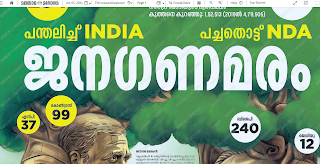
Newspaper front pages - June 5
Some images of front pages of newspapers after votes were counted on June 4, 2024 after a ridiculously long parliament elections. Did the ...